

Benefits of Tankless Water Heaters: 2026 Guide

Table of Contents
What Are Tankless Water Heaters and How Do They Work?
Endless Hot Water and Space-Saving Design
Energy Efficiency and Utility Bill Savings
Tankless Water Heater Installation Cost: What to Expect
Tankless Water Heater Maintenance and Water Quality
Tankless Water Heater Lifespan and Long-Term Value
Pros, Cons, and Hidden Costs of Tankless Systems
Conclusion
Frequently Asked Questions
Last Updated: September 27, 2026
What Are Tankless Water Heaters and How Do They Work?
The benefits of tankless water heaters start with a simple design difference: they heat water on demand instead of storing it in a tank. A tankless unit, also called an on-demand water heater, is a compact appliance that raises the temperature of water as it flows through a heat exchanger. Cold water enters the unit, a gas burner or electric resistance element fires up, and hot water reaches your fixtures within seconds.
Storage tank heaters keep 40 to 80 gallons hot around the clock, which means standby energy loss every hour of every day. Tankless models only consume energy when a tap opens. That single change drives most of the advantages below, from endless hot water to a smaller carbon footprint. At Causeway Plumbing LLC, we install and service these systems across the greater Hampton Roads area.
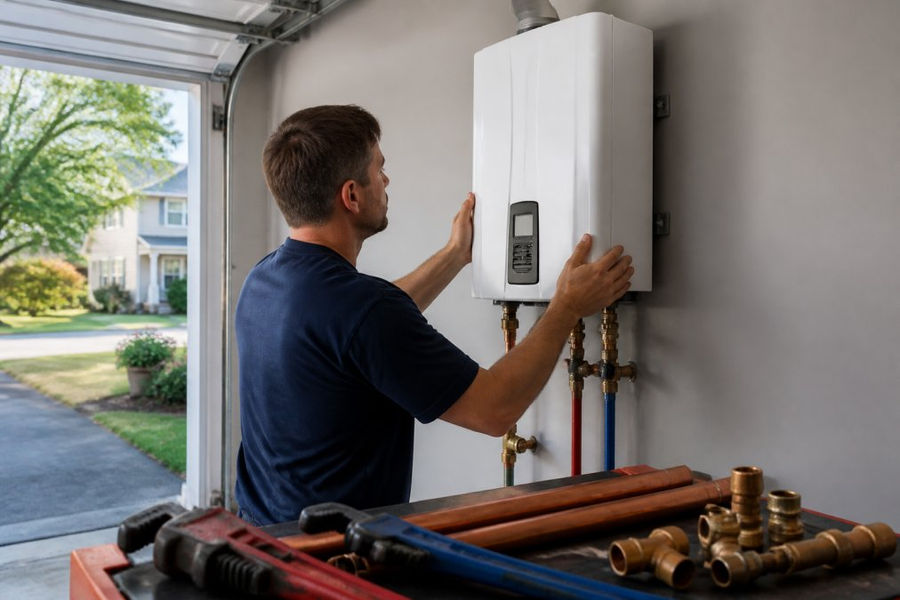
Two specifications decide how well a unit performs. Flow rate, measured in gallons per minute (GPM), tells you how much hot water the heater can deliver at once. Temperature rise is the difference between incoming groundwater temperature and your target output. A unit rated for a large temperature rise in a cold climate may struggle in a warm one, so sizing matters more than brand.
Endless Hot Water and Space-Saving Design
Endless hot water is the headline feature, and it holds up in practice. Because there is no tank to drain, a properly sized tankless unit keeps producing hot water for as long as the demand continues. The catch is capacity: run a shower, a dishwasher, and two sinks at once and you may exceed the unit's flow rate. Most households find that a single unit handles two simultaneous fixtures comfortably.
Space savings are just as real. A tankless heater mounts on a wall and takes up roughly the footprint of a carry-on suitcase, freeing garage or closet space that a tank once claimed. For property managers overseeing multiple units, that reclaimed space and the continuous supply are practical wins.
Pro Tip When sizing for endless hot water, add up the GPM of every fixture you expect to run at the same time, then add a small buffer. Undersizing is the most common reason homeowners feel let down by a tankless system.
Energy Efficiency and Utility Bill Savings
Energy efficiency is where tankless systems earn their reputation, but the savings depend on how much hot water you use. The U.S. Department of Energy notes that tankless water heaters can be more efficient than storage models because they avoid standby energy loss, the heat that escapes from a tank all day. That advantage grows with household size: the more hot water you use, the more standby loss you avoid.
SharkBite Plumbing
For homes that use very little hot water, the gap narrows. A small household with low demand may see only modest utility bill savings, because the standby loss it avoids was never large to begin with. Gas condensing units, which capture heat that non-condensing models vent away, tend to deliver the strongest efficiency gains. Electric resistance units are simpler to install but generally cost more to operate than natural gas models.
Tankless Water Heater Installation Cost: What to Expect
Project Factor | Why It Affects Cost | What to Check |
Gas line sizing | Higher BTU input may need a larger line | Current line diameter and run length |
Venting requirements | Condensing vs non-condensing units vent differently | Available wall or roof vent path |
Electrical | Electric units need dedicated circuits | Panel capacity and voltage |
Plumbing retrofit | Relocating supply and hot lines | Distance from fixtures |
Water quality | Hard water may require a softener | Local water hardness |
Watch Out Skipping a proper load calculation to save on the estimate is a false economy. An undersized gas line or vent can force a costly redo, and it may void the manufacturer's warranty.
The honest way to price your project is to get a written estimate that itemizes the unit, labor, venting, and any gas or electrical upgrades separately. That breakdown lets you compare bids apples to apples and see which contractor is padding the labor line.
Key Takeaway Retrofits cost more than new construction because new builds plan for the gas line, vent path, and electrical circuit before the drywall goes up. If you are building, spec the tankless unit early and the installation premium largely disappears.
Tankless Water Heater Maintenance and Water Quality
Pro Tip Watch for the early warning signs of scale: hot water that takes longer to arrive, a unit that cycles on and off more often, or a slight rattle from the heat exchanger. Any of these means it is time to descale, not time to replace.
For property managers with multiple rental units, a recurring maintenance schedule beats one-off service calls. It keeps units running, prevents surprise failures, and protects the warranty. Log the flush date on each unit so the next tenant turnover does not become an emergency.
Key Takeaway Hard water is the single biggest threat to a tankless heat exchanger, and it is invisible until performance drops. Test your water, set a descaling schedule based on your hardness number, and consider a softener if you are above 7 gpg.
Tankless Water Heater Lifespan and Long-Term Value
Tankless water heater lifespan is one of the strongest arguments for the investment. The U.S. Department of Energy reports that tankless units typically last longer than storage tank models, and that a tankless heater can have a longer life with proper maintenance. Where a tank might need replacing sooner, a well-maintained tankless unit can serve a home for many additional years.
Pros, Cons, and Hidden Costs of Tankless Systems
The pros and cons of tankless systems come down to upfront cost versus long-term return. The advantages are real: continuous supply, a compact design, better efficiency, and a longer lifespan. The drawbacks are equally real, and they center on installation realities rather than the appliance itself.
Pros:
Endless hot water with no tank to run dry
Lower standby energy loss and potential utility savings
Compact, wall-mounted design that frees floor space
Longer lifespan than storage tanks with proper care
Smaller carbon footprint from reduced energy waste
Cons:
Higher upfront installation cost, especially on retrofits
Possible gas line, venting, or electrical upgrades
Capacity limits when many fixtures run at once
Annual descaling needed in hard water areas
Cold-climate sizing may require a larger unit
Conclusion
Switching to a tankless system is a real decision with real trade-offs, and the right answer depends on your home, your water, and how you use hot water. The benefits are strongest for households with steady demand and homes that can accommodate the installation. If you are weighing the upgrade, the Causeway Plumbing LLC team can walk you through the installation realities, and keep it running with a maintenance schedule built around your water quality.
Frequently Asked Questions
What is the downside of a tankless water heater?
Tankless water heaters cost more upfront than tank models, and installation can require upgrades like larger gas lines or electrical panels. They also need annual descaling in hard water areas, and if the power goes out, you lose hot water immediately. Some units have a minimum flow rate to activate, so low-flow fixtures might not trigger heating. Despite these drawbacks, many homeowners find the long-term savings and endless hot water outweigh the initial investment.
How often do I need to flush my tankless water heater if I have a water softener?
With a water softener, you can typically flush your tankless water heater once every 18 to 24 months instead of annually. Softened water reduces scale buildup, which is the main reason for flushing. Without a softener, manufacturers usually recommend descaling every 12 months. Always check your unit's manual for the specific maintenance schedule, and if you notice reduced flow or inconsistent temperatures, it's time for a flush regardless of the calendar.
How much does your electric bill go up with a tankless water heater?
Your electric bill may go up slightly because tankless units draw a lot of power when heating water, but overall energy use typically drops. Tankless heaters only heat water on demand, eliminating standby energy loss from a storage tank. The U.S. Department of Energy estimates that tankless water heaters can be 24% to 34% more efficient than tank models for homes using less than 41 gallons per day. Actual savings depend on your usage, local utility rates, and the unit's energy factor.
Do you ever run out of hot water with tankless?
A properly sized tankless water heater provides a continuous supply of hot water, so you won't run out like you would with a tank. However, if you use multiple hot water appliances at once and exceed the unit's flow rate (measured in gallons per minute), you may notice a temperature drop. Sizing the unit to your household's peak demand is key. For homes with high simultaneous demand, a condensing unit or multiple point-of-use heaters can help.
How long do tankless water heaters typically last compared to tank models?
Tankless water heaters have a lifespan of about 20 years, while traditional tank models last 10 to 15 years. The longer life of tankless units is due to fewer parts that wear out and no standing water to corrode the tank. With regular maintenance, such as annual descaling, you can maximize that lifespan. Over 20 years, you might replace a tank heater once while a tankless unit keeps running, making it a more durable long-term choice.
Can a tankless water heater handle cold groundwater temperatures?
Yes, but cold groundwater affects performance. Incoming water temperature in northern states can be as low as 40°F, requiring a larger temperature rise and reducing flow rate. Gas tankless heaters with high BTU input handle this better than electric models. For cold climates, consider a condensing unit, which captures more heat, or a system with a recirculation loop. Proper sizing and insulation of pipes also help maintain output during winter.
Get In Touch


Comments